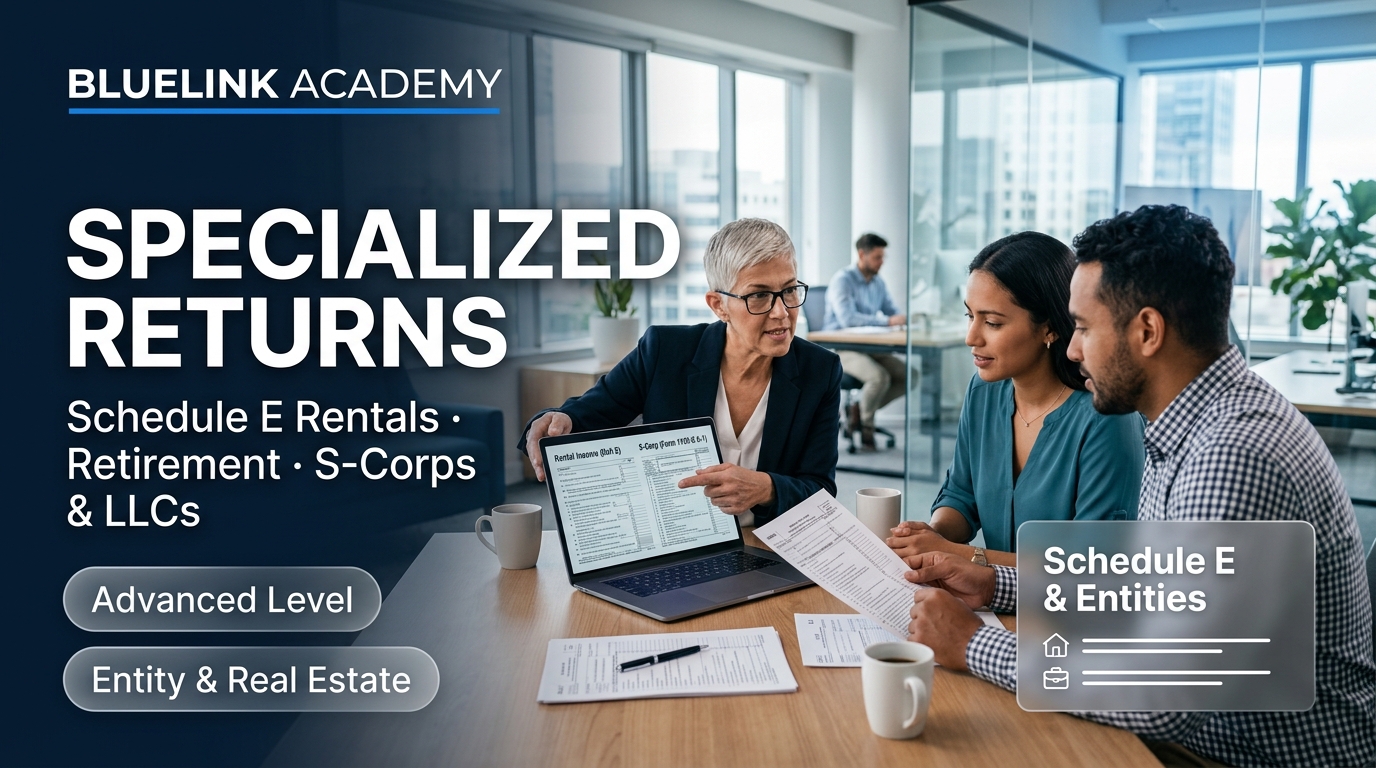
Master Schedule E rental real estate, 2026 retirement plans, and business entity taxation across LLCs, S-Corps, and C-Corps.
☆☆☆☆☆(0.0 · 0 reviews)
0 Enrolled
30 Lectures
Shmuel Eagle
Instructor
What Will You Learn
Report gross rental income and advance rents accurately on Schedule E
Distinguish deductible repairs from capitalized property improvements
Compute 27.5-year MACRS residential rental depreciation on Form 4562
Apply passive activity loss rules and the $25,000 active allowance on 8582
Apply 2026 traditional and Roth IRA contribution limits and phase-out rules
Calculate maximum contributions for SEP-IRAs, SIMPLE IRAs, and Solo 401(k)s
Complete Form 8606 for nondeductible contributions and backdoor Roth IRAs
Contrast tax treatment of sole props, LLCs, S-Corps, and C-Corps
Establish reasonable compensation for S-Corp shareholder-employees
Calculate Section 199A Qualified Business Income deductions across entities
About This Class
Course & Unit Overview: Specialized Returns (Classes 25–27)
Welcome to Unit 8 of BlueLink Academy’s 1040 Income Tax Preparation Course. Specialized individual returns—covering rental real estate on Schedule E, complex retirement contribution mechanics, and pass-through business entities (LLCs, Partnerships, and S-Corporations)—represent high-margin preparation and advisory engagements. This unit equips you to master depreciation on Form 4562, passive activity losses, backdoor Roth IRAs, and S-Corp reasonable compensation.
The Preparer's Mindset
Moving beyond basic W-2 returns into Schedule E and pass-through entities is how tax professionals double their revenue per return. Complex returns require understanding the underlying economics of real estate and business structures, not just knowing which box to type in software.
Unit Curriculum Architecture
Class 25
Rental Income & Schedule E
Rental receipts, advance rents, repairs vs improvements safe harbors, 27.5-year MACRS depreciation, and Form 8582 passive loss rules.
Class 26
Retirement Contributions & Planning
Traditional vs Roth IRAs ($7,500/$8,600), employer 401(k) plans, SEP-IRAs ($72k max), backdoor Roth IRAs, and Form 8606 pro-rata rules.
Class 27
Business Entities & Tax Treatment
Disregarded LLCs, Form 1065 partnerships / K-1, S-Corporations (Form 1120-S) with reasonable compensation, and Section 199A QBI.
Unit Quick Reference Table
Specialized Tax Topic
Tax Form / Code
2026 Statutory Standard
Residential Rental Depreciation
Form 4562 / MACRS
27.5-year straight line (mid-month convention; land not depreciable)
De Minimis Expense Safe Harbor
Treas. Reg. §1.263(a)-1
Expense rental repairs up to $2,500 per invoice/item directly
Passive Rental Loss Allowance
Form 8582
$25,000 special active allowance (phases out between $100k–$150k MAGI)
Self-Employed SEP IRA Max
IRC §408(k)
Up to 25% net compensation or $72,000 maximum contribution
S-Corporation Election Deadline
Form 2553
Filed within 2 months and 15 days of the start of the tax year
Requirements
Completion of Units 1 through 7 of the 1040 Preparation Program
Strong foundation in Form 1040, Schedule C, and depreciation basics
Access to tax preparation software and financial calculator
Access to 2026 retirement limits, MACRS tables, and entity forms
Commitment to accurate multi-year tax planning and compliance
Frequently Asked Questions
How do you distinguish between a deductible repair and a capitalized improvement on Schedule E?
A repair keeps the property in an ordinary, efficient operating condition (e.g., fixing a leak, patching drywall, painting). An improvement adds value, prolongs property life, or adapts it to a new use (e.g., replacing an entire roof, installing new HVAC). Improvements must be capitalized and depreciated under the IRS Tangible Property Regulations, subject to the $2,500 De Minimis Safe Harbor election.
What is the recovery period and method for residential rental property depreciation?
Under MACRS (Modified Accelerated Cost Recovery System), residential rental property is depreciated over a 27.5-year recovery period using the straight-line method and the mid-month convention. Depreciation applies only to the building and physical improvements, never to the land value.
How does the $25,000 passive activity loss special allowance work on Form 8582?
Taxpayers who "actively participate" in rental real estate can deduct up to $25,000 in net rental losses against non-passive income (such as W-2 wages). This allowance phases out by 50 cents for every dollar of Modified AGI between $100,000 and $150,000 (completely phasing out at $150,000).
What is the 14-day / 10% rule for personal use of a rental property?
If personal use of a vacation rental exceeds the greater of 14 days or 10% of total days rented at fair market value, the property is classified as a personal residence. In that case, rental deductions cannot exceed rental income (losses cannot offset other income). If rented for fewer than 15 days per year, rental income is completely tax-free under the Augusta Rule.
What is the pro-rata rule on Form 8606 for Backdoor Roth IRAs?
When executing a backdoor Roth IRA conversion, the IRS aggregates all of a taxpayer's traditional, SEP, and SIMPLE IRAs to determine the taxable percentage of the conversion. If the taxpayer has pre-tax IRA balances, they cannot convert only the nondeductible basis; the conversion is taxed proportionally based on the ratio of pre-tax to after-tax dollars.
What is the maximum SEP-IRA contribution limit for 2026?
For 2026, a self-employed individual can contribute up to 25% of net adjusted self-employment earnings (effective rate approximately 20%), up to a statutory cap of $72,000. SEP-IRAs are funded entirely by employer contributions and can be established and funded up to the taxpayer's return due date including extensions.
How is a Single-Member LLC (SMLLC) taxed by default?
By default, the IRS treats a single-member LLC as a "disregarded entity" for federal income tax purposes. The owner reports all business income and expenses on Schedule C of their individual Form 1040, subject to ordinary income tax and self-employment tax (15.3%).
How does an S Corporation save on self-employment taxes?
An S Corporation allows owner-employees to take earnings in two forms: (1) W-2 wages, which are subject to payroll taxes (FICA), and (2) shareholder distributions of net profit, which are exempt from self-employment taxes. However, the owner must be paid "reasonable compensation" via W-2 for services rendered before distributions can be taken.
Who qualifies for the Section 199A Qualified Business Income (QBI) deduction?
Eligible non-corporate taxpayers (sole proprietors, partners, S-Corp shareholders, and LLC members) can deduct up to 20% of their Qualified Business Income (QBI). For 2026, full deductions apply below income thresholds (under $201,750 Single / $403,500 MFJ), with phase-outs and W-2 wage / property limits applying above those levels, especially for Specified Service Trades or Businesses (SSTBs).
When should an LLC make an S Corporation election using Form 2553?
An S-Corp election typically becomes financially advantageous when net business profits consistently exceed reasonable owner compensation by enough margin to justify the extra costs of payroll processing, corporate tax returns (Form 1120-S), and state corporate franchise fees—usually around $60,000 to $80,000+ in net profit.
Meet Your Instructors
Shmuel Eagle
Lead Tax Instructor
Co-founder of BlueLink with 15+ years in tax preparation and office management.
Class Curriculum
Class 25 — Rental Income & Schedule E10 lessons
25.0 Rental Income & Schedule E . Video31 min
25.1 Welcome & Introduction to Real Estate Taxation5 min
25.2 Reporting Rental Receipts & Advance Rent Rules5 min
25.3 Deductible Rental Operating Expenses5 min
25.4 Repairs vs. Improvements & Tangible Property Safe Harbors5 min
25.5 Depreciation Mechanics & Form 45625 min
25.6 Vacation Homes & Personal Use Rules (14-Day / 10% Rule)5 min
25.7 Passive Activity Losses & The $25,000 Special Allowance5 min
25.8 Class Recap & Closing5 min
Class 25 Knowledge Check5 min
Class 26 — Retirement Contributions & Tax Implications10 lessons
26.0 Retirement Contributions & Tax Implications . Video29 min
26.1 The Retirement Planning Landscape5 min
26.2 Traditional & Roth IRAs: 2026 Contribution & Phase-Out Rules5 min
26.3 Employer-Sponsored Plans: 401(k), 403(b) & 457 Deferrals5 min
26.4 Self-Employed Retirement Plans: SEP-IRA, SIMPLE & Solo 401(k)5 min
26.5 Backdoor Roth IRAs & Form 8606 Pro-Rata Rules5 min
26.6 SECURE 2.0 & 2026 OBBBA Retirement Changes5 min
26.7 Excess Contributions, Excise Tax & Corrective Distributions5 min
26.8 Class Recap & Closing5 min
Class 26 Knowledge Check5 min
Class 27 — Business Entities & Tax Treatment10 lessons
27.0 Business Entities & Tax Treatment . Video28 min
27.1 Welcome & The Business Entity Landscape5 min
27.2 Sole Proprietorships & Single-Member LLCs (Schedule C)5 min

Discussion for enrolled students only. Comments are reviewed by our team before they appear publicly. You must be enrolled in this class to post.
Sign in and enroll to participate in class discussions.
Discussion
No comments yet
Be the first to start the discussion once comments are approved.